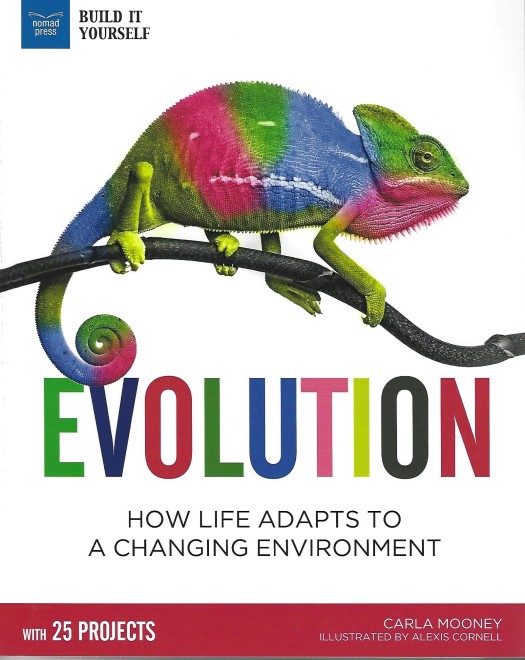
Evolution: How Life Adapts to a Changing Environment With 25 Projects
by Carla Mooney (Author) and Aleis Cornell (Illustrator)
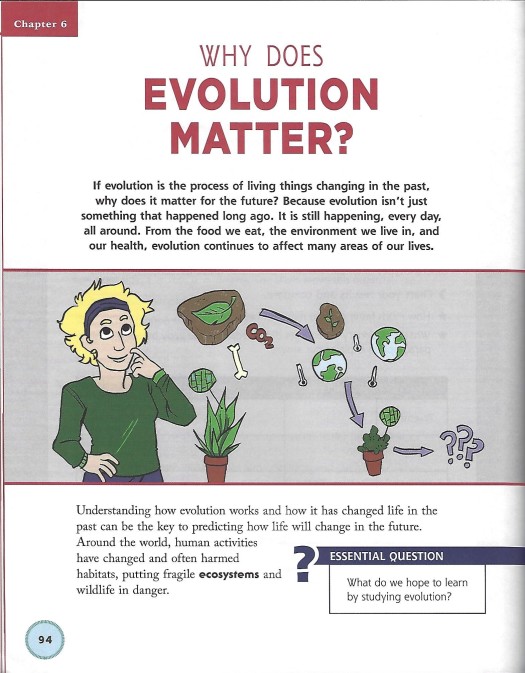
Booktalk: In this hands-on, problem-solving book, readers ages 9 to 12 will study evolution, or the process by which living things change over time. One of the most important ideas in biology, evolution explains why there are so many different living organisms on earth. It also explains why you are the way you are. Because of evolution, you walk on two legs and communicate with language. And although evolution is the story of our past, it also helps us understand our future and how we continue to evolve.
Throughout the book, investigations and experiments provide hands-on, problem-solving opportunities for students, incorporating various challenges and tools. Readers simulate the process of natural selection, trace the blue whale’s evolutionary tree, and examine how fossils provide evidence of evolution and adaptation. Using readily available household and recycled materials, each activity takes the reader through an inquiry-based, open-ended investigation that leaves plenty of room to explore individual creativity.
Snippet:
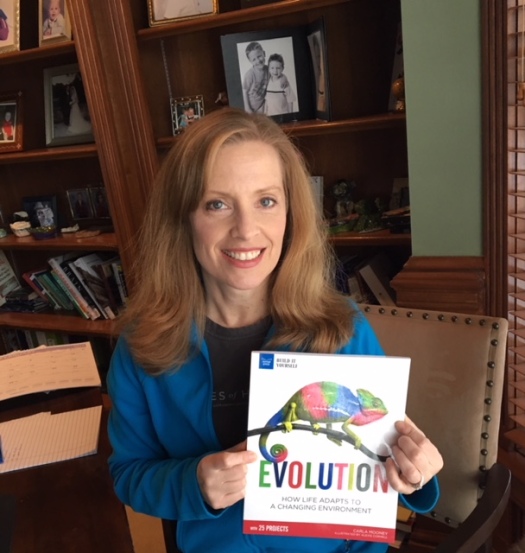
Guest Post by Carla Mooney
Carla Mooney has written over 70 books for children, focusing on topics in science, social studies, and current issues. She has a particular interest in projects that enable her to explore history, science, and how the world works.
Q. Describe your writing process.
A. Research, research, and more research! When I start a new book project, one of the first things I do is go online to see what has already been written about the subject. What children’s books have been written on my topic? What adult books are in print? What primary sources exist? Then, I order as many as I can from my local library. By reviewing the existing children’s and adult books, I can get a sense as to how other authors have already covered this material, which can help me find a new angle or develop a different approach to the subject.
I also use the Internet when I research. I’ve become a big fan of gathering background information about a subject by listening to or watching audio or video lectures and courses. I use search engines and my library’s research databases to see what articles, scientific papers, or research studies have been published about the topic. A word of caution — always make sure that you check the validity of a website or the publisher of a book to make sure it is a reliable source. For many books, I’ll contact experts in the field — like professors or scientists — and interview them either in person, over the phone, or through email.
Once I’ve gathered all of my research materials, I actually like to sit down with a notebook and pen and take notes. Something about physically writing notes the old-fashioned way helps me to “see” how I want to organize the book. From these notes, I create an outline.
With my outline, I’m ready to start writing on my laptop. At this point, I often do some additional research to gather more sources or fill in areas as I write. I love it when I find just the right fact or detail for a section! I don’t try to say everything perfectly in the first draft — it’s more important to get it started. Once I have finished the first draft, I go back to edit and edit, until I’m happy with the manuscript.
Q. Tell us about your latest book.
A. Have you ever wondered why fish have gills and humans walk on two legs? Life on Earth is incredible diverse, and part of the reason for this is evolution, or the theory that living things change with time. Evolution: How Life Adapts to a Changing Environment explores the theory of evolution, its history, and how we think it works. In this book, you’ll learn about examples of creatures that have evolved in response to specific circumstances and what evolution might mean for the future of our planet. And one of my favorite things about this book — it’s full of projects and activities that really help readers explore and learn about the science of evolution. Are you ready to take a journey to explore our common ancestors and look toward our shared future?
Thanks for sharing your new book, Carla!

February 12th is Charles Darwin’s birthday.
Copyright © 2018 Anastasia Suen All Rights Reserved.