Global Citizenship: Engage in the Politics of a Changing World

Amazon | Bookshop | IndieBound

Global Citizenship: Engage in the Politics of a Changing World
by Julie Knutson (Author) and Traci Van Wagoner (Illustrator)

Booktalk: Readers ages 12 to 15 discover the resources and information they need to learn about issues of global concern and strategies for taking informed action, as outlined by the Sustainable Development Goals set in 2015 by the United Nations General Assembly.

Each chapter centers on a specific human right defined by the United Nations’ “Convention on the Rights of the Child,” focusing on the political, human, economic, environmental, and cultural guarantees born of our common humanity. Readers learn about the history and evolution of citizenship, about past and ongoing human rights struggles, about economic justice, and about environmental sustainability and the climate protests happening around the world. They also learn about cultural appreciation and preservation in an age of global convergence. All of these issues have major ties to the present and align with the values being described by today’s movements, such as Black Lives Matter, which aims to reduce violence toward Black communities and individuals.

The book also has QR codes that can be accessed with a phone or tablet. A list of the QR code URLs also appears in the Resources at the end of the book.

Snippet:


Nonfiction Monday

It’s Nonfiction Monday!

Copyright © 2020 Anastasia Suen All Rights Reserved.

Birding Adventures for Kids: Bird Identification & Activities

Cindy: At the public library, Lynn found this great new birding guide for children getting started in this rewarding hobby that gets them outside and active. Audubon Birding Adventures for Kids (Quarto, 2020) by Elissa Wolfson and Margaret A. Barker is more than just an identification guide. It’s divided into three sections: Meet the Birds, Outside with Birds, and Inside with Birds, the last two provide ideas and directions for games, activities, and adventures to have in order to learn more about the birds.

Most of the 25 birds selected for the Meet the Birds section are ones that are found throughout the United States at one season or another. A range map is provided for each species, just as is provided in identification books published for adults. A color photo of a single or pair of the species is included along with a “fun fact.” Did you know that Hummingbird eggs are the size of peas? Each species is identified by common name, scientific name, field marks, length (in inches and centimeters), and voice descriptions for songs and calls. There’s also information on feeding (what they eat and how they consume it), conservation issues, tips for helping the species (food or plants to provide), and similar species. There are also a few groan-worthy bird jokes thrown in for fun. “What kind of crows always stick together?….Vel-crows!” HAHAHAHA.

Lynn: Following the section Cindy describes are two more sections that the parent/grandparent in me loved. These are the sections that get kids moving, learning, and entertained. These two chapters provide well-designed activities, one set for outside and one for inside. Each activity clearly lists materials needed, directions, follow up, and discoveries. Some are more involved than others but most require just simple materials. One does require binoculars but I liked this one too as a good basic lesson on how to use binoculars. Glossary and an appendix have related bird information.

I learned a lot myself from the information on common birds despite being a life-long birder. Did you know only the female duck “quacks”? Or that Chickadees hide seeds and go back to them months later? This appealing book will help create more birders and will keep kids nicely occupied with science and bird-related activities. This is an ideal book for kids and caregivers both and may be of special interest to everyone with children doing virtual school in this time of Covid-19.

Visit us at Bookends!

Facts vs. Opinions vs. Robots: A Fun Information Literacy Primer for Children

Lynn: You’d have to live in a cave in the wilderness not to know that far too many Americans have a very sketchy concept of what a fact actually is or how to verify it. The need to understand this important issue is one of national importance these days as it is clear that millions of adults don’t grasp the difference and the impact on our culture is stark. Here, with a great way to start addressing the issue, is Michael Rex with a fabulous picture book, Facts vs. Opinions vs. Robots (Penguin/Nancy Paulsen, 2020). With brightly colored cartoon-style robots, Rex’s appealing book takes on this topic with our youngest readers. The question is posed on the very first page.

“Do you know the difference between a fact and an opinion?

It can be a hard thing to understand. Even these robots get confused.

But maybe if we work together, we can figure it out.”

Taking it step by step, the robots define the two concepts and then provide simple examples to practice. The examples are engaging and child-centered with plenty of humor. The robots are goofy but Rex does a wonderful job of presenting the information in a clear, understandable, and appealing way. Kids are going to WANT to read this book all the way through thanks to the level of humor but more importantly, they are going to grasp and remember this idea. The story also includes the concept of needing to search for more information sometimes and also reminds readers that while we need to respect other people’s opinions, we can’t argue with facts.

If I could, I’d buy this book for every classroom and library in America!

Cindy: What a great way to introduce an important skill in information literacy. Elementary librarians, take note! What if you read this book aloud and then had your students write a declarative sentence and have them present it for the other students to respond with Fact or Opinion? This could work in a virtual class meeting as well. Students could make a 2-sided notecard with the FACT on one side and OPINION on the other and hold them up to their cameras. Lots of ways to use this in an elementary classroom as well.
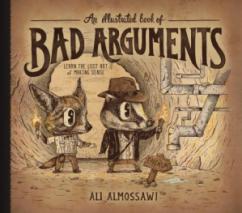
This book for the very young audience brings to mind a book for older students that we reviewed over at Booklist Reader during the last presidential election cycle and it’s worth mentioning again as the facts, opinions, and faulty logic arguments ratchet up. Read our blog post about Bad Arguments: Learning the Lost Art of Making Sense (The Experiment, 2014) by Ali Almossawi if you missed it the first time around. It’s a good time to separate facts from opinions and to do it without faulty logic.


VISIT US!

Gridiron: Stories from 100 Years of the National Football League

Amazon | Bookshop | IndieBound

Gridiron: Stories from 100 Years of the National Football League
by Fred Bowen (Author) and James E. Ransome (Illustrator)

Booktalk: The National Football League is the most popular sports league in the United States. Its championship game, the Super Bowl, is watched by millions of people every year. But it wasn’t always like this. In the last one hundred years, football has changed from a poorly organized, often overlooked sport to America’s favorite pastime. Discover the league’s scrappy beginnings in an automobile showroom, and early players like Red Grange, the Galloping Ghost. Relive the very first championship game, played indoors after a circus had visited, and famous games like the Ice Bowl. See the NFL at war, and meet some of the remarkable athletes who helped desegregate the league. Learn how the draft came into existence, and about the teams that strove for that almost impossible goal–a perfect season.

Snippet:


Hear the author talk about the book.

Nonfiction Monday

It’s Nonfiction Monday!

Copyright © 2020 Anastasia Suen All Rights Reserved.

Rare and Blue: Finding Nature’s Treasures

Have you seen the gorgeous new picture book Rare and Blue: Finding Nature’s Treasures by Constance Van Hoven and illustrated by Alan Marks?

Although we are used to seeing blue skies and bodies of water every day, blue plants and animals are less usual, and some are extremely uncommon. Most of us may have seen a blue jay, but what about a cerulean warbler? Take a trip around the world to find eight rare or endangered species that are shades of blue, then learn about why their numbers may be dwindling and what can be done. End with a trip that is out of our world.

The layered text works well. In bold print is a challenge for the reader to find a blue plant or animal:

To find electric blue,
hike into a tall forest,
Listen for…

with the answer appropriately in blue font. The secondary text gives more details about the organism and why they are in decline.

Rare and Blue is a visual treat that will intrigue young scientists and artists alike. Tour a copy today!

For the full review and activity suggestions, visit Wrapped in Foil blog.

Copyright © 2020 Roberta Gibson All Rights Reserved.

Every Second: 100 Lightning Strikes, 8,000 Scoops of Ice Cream, 200,000 Text Messages, 1 Million Gallons of Cow Burps … and Other Incredible Things That Happen Each Second Around the World

Amazon | Bookshop | IndieBound

Every Second: 100 Lightning Strikes, 8,000 Scoops of Ice Cream, 200,000 Text Messages, 1 Million Gallons of Cow Burps … and Other Incredible Things That Happen Each Second Around the World
by Bruno Gibert (Author / Illustrator)

Booktalk: See some of the incredible things that happen each and every second in our world! A unique introduction to numbers and statistics for kids in kindergarten and elementary school.

Snippet:


Nonfiction Monday

It’s Nonfiction Monday!

Copyright © 2020 Anastasia Suen All Rights Reserved.

A Bowl Full of Peace: A True Story

Amazon | Bookshop | IndieBound

A Bowl Full of Peace: A True Story
by Caren Stelson (Author) and Akira Kusaka (Illustrator)

Booktalk: Sachiko’s family home was about half a mile from where the atomic bomb fell on August 9, 1945. Her family experienced devastating loss. When they returned to the rubble where their home once stood, her father miraculously found their serving bowl fully intact. This delicate, green, leaf-shaped bowl–which once held their daily meals–now holds memories of the past and serves as a vessel of hope, peace, and new traditions for Sachiko and the surviving members of her family.

Snippet:

Nonfiction Monday

It’s Nonfiction Monday!

Copyright © 2020 Anastasia Suen All Rights Reserved.

W is for Welcome: A Celebration of America’s Diversity

Amazon | Bookshop | IndieBound

W is for Welcome: A Celebration of America’s Diversity
by Brad Herzog (Author)

Booktalk: Following the alphabet this book uses poetry and expository text to celebrate America’s diverse population and showcase the remarkable achievements and contributions that have come from the many people who have chosen to make our country their home. Topics include well-known landmarks and institutions (the Statue of Liberty and the White House, our national parks system) and famous citizens whose talents helped make the United States a world leader (Albert Einstein and Madeleine Albright). In addition to celebrating America’s history and development, key concepts such as naturalization and steps to citizenship are explained in easy-to-understand terms for the young reader.

Snippet: Each year millions of people leave their homelands to start new lives in another country. They emigrate from their birth nation and immigrate to a new one. America, in particular, is made up of immigrants and their descendants. Everyone is here because their ancestors “migrated” (moved from one place to another). Some of them, such as the ancestors of Native Americans, migrated to North America very long ago. Many other arrived against their will. For instance, hundreds of thousands of Africans were forced to come here and were enslaved. But over the centuries, the United States has welcomed millions of strangers to its shores.

A is for America
a dreamer’s destination
made up of people who are here
due to immigration.

Nonfiction Monday

It’s Nonfiction Monday!

Copyright © 2020 Anastasia Suen All Rights Reserved.